For more than two decades, getting found online usually meant one thing: getting found on Google.
That isn’t disappearing. However, the way people search is changing remarkably quickly.
Customers can now ask an AI assistant to recommend a web designer, compare local businesses or explain which service is right for them. Meanwhile, Google itself increasingly answers complex questions directly through AI-powered search.
So, is Google dying?
No. In fact, Google says search volumes have reached record levels. However, AI search for businesses is changing what being “visible online” actually means.
And businesses that understand that distinction have an opportunity.
Search Is Becoming a Conversation
Traditional Google searches are generally short.
Someone might type:
“web designer Cambridge”
or:
“SEO company near me”
AI search allows something much more specific:
“I’m a small construction company in Cambridge with an outdated WordPress website. I need a company that can redesign it, improve my Google rankings and manage everything afterwards. Who should I consider?”
That’s a completely different type of search.
Instead of ten blue links, the customer may receive a detailed answer containing several recommended businesses, sources and explanations.
Therefore, businesses increasingly need to consider whether AI systems understand who they are, what they offer and why they’re relevant.
Google Has Already Changed
This isn’t a prediction about something happening in five years.
Google’s AI Overviews now reach more than 2.5 billion monthly users, while AI Mode has surpassed one billion monthly users. Google has also introduced Search Console reporting that helps website owners understand appearances within its generative AI search features.
Nevertheless, this doesn’t mean traditional SEO has suddenly become obsolete.
Quite the opposite.
Google’s own guidance is refreshingly straightforward: good foundational SEO remains fundamental to visibility in its AI-powered search experiences.
What Does AI Search Mean for Your Website?
Businesses shouldn’t start filling their websites with strange phrases written for robots.
They should concentrate on becoming genuinely useful sources of information.
That means publishing content that clearly demonstrates:
- What you do
- Who you help
- Where you operate
- What problems you solve
- Your experience
- Your services
- Your expertise
- Real examples of your work
Your service pages matter. Your portfolio matters. Your reviews matter. Your blog matters.
Furthermore, information about your business elsewhere online increasingly contributes to the wider picture.
SEO Is Becoming Bigger Than Rankings
For years, businesses obsessed over whether they ranked first, third or tenth.
Those rankings still matter.
However, modern visibility is becoming broader.
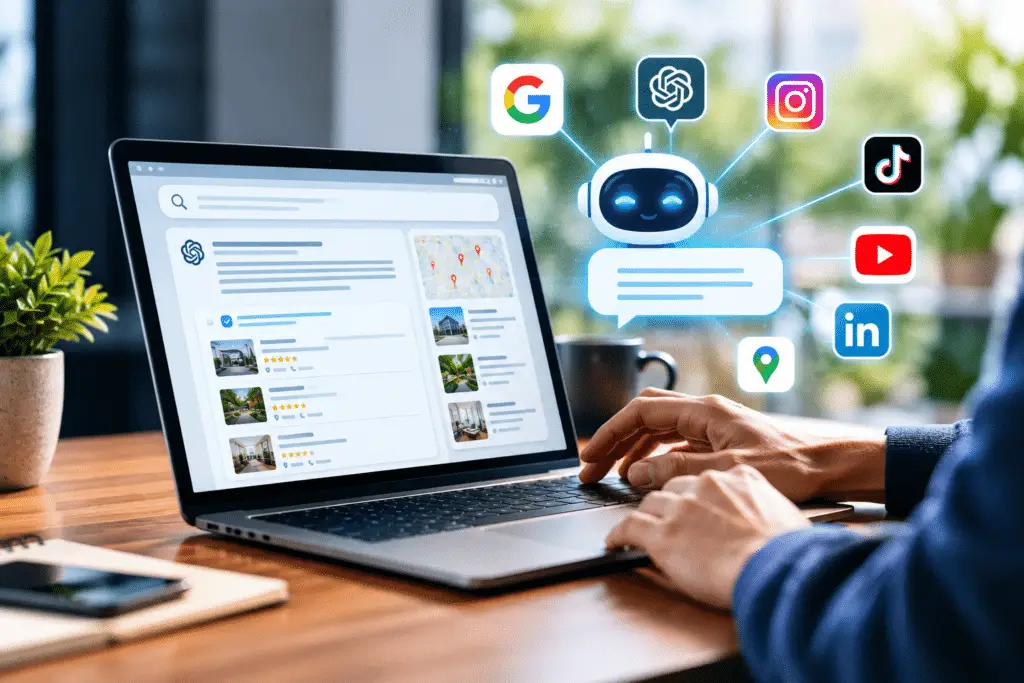
A potential customer could discover your company through Google, an AI-generated answer, LinkedIn, Instagram, YouTube, a review website or an article that mentions your business.
Consequently, successful digital marketing increasingly means building a recognisable online entity, rather than merely optimising individual webpages.
Should Businesses Start Optimising for ChatGPT?
Yes—but not by abandoning Google.
The sensible approach is ensuring your existing digital presence provides clear, authoritative information that both people and machines can understand.
Useful steps include publishing detailed service pages, answering genuine customer questions, creating original articles, adding structured data and maintaining consistent company information.
Most importantly, create material worth finding.
Producing 100 generic AI-written articles isn’t a clever shortcut.
Publishing ten genuinely useful pieces demonstrating real knowledge can be considerably more valuable.
The Businesses That Benefit Will Be the Useful Ones
AI may be changing search technology, but something surprisingly traditional remains at the centre of it:
being useful.
A business with an excellent website, genuine expertise, strong content, clear services and credible external references gives search systems significantly more information to work with.
Therefore, don’t ask whether Google is dying.
Ask a better question:
If somebody asks the internet for exactly what my business provides, will the internet know enough about my company to recommend it?
That is becoming the new search challenge.
Preparing Your Business for AI Search
At CFM Group, we help businesses create digital presences designed for modern search rather than yesterday’s internet.
From professional website design and SEO to content, social media and digital marketing, the objective is simple: make your business easier to discover, understand and trust.
Because whether your next customer searches through Google, social media or an AI assistant, being invisible isn’t much of a marketing strategy.
FAQs
Will AI replace Google Search?
Probably not. Google itself is integrating AI directly into Search, so AI is more likely to transform search than replace it.
Does normal SEO still matter?
Absolutely. Google states that its AI search experiences use the same fundamental search infrastructure and quality systems as traditional Search.
Can ChatGPT recommend businesses?
AI assistants can surface and discuss businesses using information available to them. This makes a clear, credible online presence increasingly important.
Should small businesses invest in AI SEO?
Businesses should first ensure their technical SEO, website content and wider digital presence are strong before chasing specialist AI optimisation tactics.