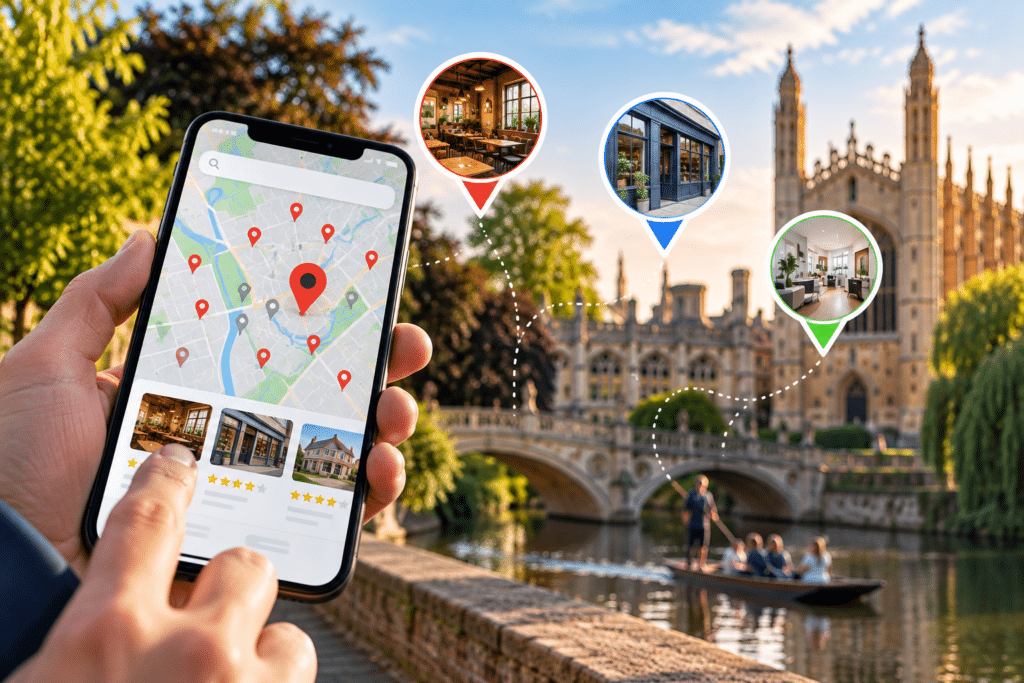
You search for the service your business provides in Cambridge.
Your competitors appear.
You don’t.
So you try another search. Then another. You add “Cambridge”, try “near me”, check Google Maps and scroll further down.
Still nothing.
For a local business, that’s more than irritating. Someone searching Google for a plumber, accountant, restaurant, beauty clinic, builder, solicitor or marketing agency nearby may already be looking to buy. If competitors dominate those results while your business is difficult to find, they are being considered before you are.
The good news is that disappearing from local results doesn’t necessarily mean Google dislikes your business. Usually, there are identifiable reasons why one company has stronger local visibility than another.
Understanding how Google Maps ranking in Cambridge works is therefore a useful place to start.
Google Doesn’t Simply Rank the Closest Business
There’s a common misconception that Google Maps works like a digital Yellow Pages ordered by distance.
It doesn’t.
Google says local results are mainly determined by three factors: relevance, distance and prominence.
Relevance considers how closely a business matches what somebody searched for. Distance considers the location of the searcher in relation to potential results. Prominence considers how established or well-known a business appears to be.
This explains why two people in different parts of Cambridge can perform the same search and see different results.
It also explains why simply having a Cambridge address doesn’t guarantee a prominent position.
Problem 1: Google Isn’t Completely Sure What You Do
Imagine your company provides bathroom installations, but your Google Business Profile simply describes you as a “property company”.
A potential customer searches:
bathroom installer Cambridge
Google now needs to decide which businesses are most relevant.
The company with a detailed profile, appropriate business category, bathroom services, photographs, reviews discussing bathroom installations and a website containing a dedicated bathroom page gives Google considerably more context.
Your business may be perfectly capable of doing the job. However, your competitor has made that easier for Google to understand.
That’s why vague online marketing can become a local SEO problem.
Problem 2: Your Google Business Profile Has Been Neglected
Creating a Google Business Profile and forgetting about it isn’t much of a strategy.
Google recommends maintaining complete and accurate business information. Your profile can include opening hours, contact information, website details, photographs, videos, services and reviews.
Think about it from the customer’s perspective.
Business A has current photographs, accurate hours, recent reviews and detailed information.
Business B has three photographs from 2019, unanswered reviews and an old telephone number.
Which feels more trustworthy?
Google is trying to help its users find useful businesses. Keeping your profile accurate helps both Google and your potential customers.
Problem 3: Your Website and Google Profile Tell Different Stories
This is frequently overlooked.
Your website and Google Business Profile aren’t completely separate marketing assets.
Google states that information used in Business Profiles can come from several sources, including publicly available web content such as a company’s official website.
Suppose your profile says you provide services throughout Cambridge, but your website barely mentions Cambridge.
Or your profile promotes six services while the website properly explains only one.
You are creating uncertainty rather than reinforcing relevance.
A strong local presence should tell a consistent story across your website, Business Profile and wider online footprint.
Problem 4: Your Competitors Have Better Reviews
Reviews aren’t merely decorative stars beside your company name.
Google explicitly states that review quantity and positive ratings can contribute to local prominence and local ranking.
They also affect humans.
Imagine choosing between two Cambridge companies.
One has six reviews.
The other has 94 detailed reviews from customers describing the exact services you’re interested in.
Even before visiting either website, one business has established significantly more reassurance.
That doesn’t mean businesses should start chasing fake five-star reviews. They should develop a genuine process for asking satisfied customers to share their experiences.
And when customers leave reviews, respond to them.
You’re not only answering that customer. Future customers will read the conversation too.
Problem 5: Your Website Has No Local Depth
Here’s where many attempts at local SEO become ridiculous.
Adding “Cambridge” to every other sentence isn’t optimisation.
It’s annoying.
A Cambridge business should instead provide useful local context where it genuinely belongs. Your contact information, service areas, case studies, project pages, customer testimonials and relevant articles can all help demonstrate where you operate.
For example, a builder could showcase completed Cambridge projects. A restaurant can provide clear location and visitor information. A professional services company might publish genuinely useful content addressing questions asked by local clients.
The goal isn’t to shout “CAMBRIDGE!” at Google.
It’s to provide convincing evidence that your business is relevant to people searching there.
Problem 6: Nobody Else on the Web Seems to Know You Exist
Remember Google’s third factor: prominence.
Your own website naturally says you’re excellent.
Google has every reason to expect that.
What becomes interesting is what exists beyond your website.
Links from other relevant websites, legitimate business directories, press coverage, reviews and consistent business information can all contribute to a stronger online footprint. Google specifically identifies links and reviews among the signals involved in prominence.
This is why local SEO isn’t achieved by installing a WordPress plugin and waiting.
Google is trying to understand whether your business is genuinely established.
Problem 7: You’re Checking Your Ranking the Wrong Way
Searching for yourself repeatedly isn’t a reliable local SEO report.
Remember the distance factor.
Someone searching from Chesterton may see a different local result from somebody in Trumpington. Search context and location matter.
Rather than obsessively Googling yourself every morning, examine meaningful data.
Are more people finding the profile?
Are they visiting the website?
Are telephone calls increasing?
Are direction requests increasing?
Most importantly, are local enquiries increasing?
A number-one ranking is satisfying.
A full enquiry book is considerably more useful.
Google Maps Is Becoming Part of a Bigger Discovery Journey
There’s another reason local businesses should address this now.
Search behaviour is becoming more fragmented.
A customer might discover a company through Google Maps, check its Instagram account, read its reviews, visit its website and then use an AI assistant to compare options.
Your Business Profile is therefore one piece of a larger credibility puzzle.
Google describes Business Profiles as a local storefront across Maps and Search.
That is a useful way to think about them.
You wouldn’t leave the sign above your physical shop broken for three years.
Don’t do the digital equivalent.
What Should a Cambridge Business Do First?
Start by searching for your company and viewing the result as though you’ve never heard of it.
Is the information accurate? Are the photographs current? Are your principal services obvious? Is the correct website linked? Do the reviews inspire confidence? Does the website support what the profile says?
Then search for the services you actually want customers to find.
Not your company name.
Your services.
If you run an accountancy practice, what happens when somebody searches for an accountant in Cambridge?
If you’re a builder, what happens when somebody needs a Cambridge builder?
If you own a clinic, can somebody looking for your treatment find you?
That exercise often reveals a much more useful picture than searching for your own brand.
Local Customers Are Searching — Make Sure You Can Be Found
Cambridge is full of established companies, independent businesses and new ventures competing for attention.
You don’t need every person in Britain to discover your business.
For many companies, you need the right people within the right area searching for the right service.
That’s precisely why local search can be so valuable.
At CFM Group, we’re based in Cambridge and help businesses improve the connected parts of their digital presence, including websites, SEO, content, Google visibility, social media and paid advertising. Our approach is designed around generating visibility and enquiries rather than treating each channel as an isolated task.
If your competitors keep appearing when your potential customers search and your business doesn’t, don’t simply assume they’re luckier.
Find out why.
Because the next person searching Google Maps for exactly what you provide could become somebody’s next customer.
The objective is making sure they have the opportunity to find you.
Frequently Asked Questions
Why isn’t my business showing on Google Maps in Cambridge?
There isn’t one universal reason. Your Business Profile’s relevance, the searcher’s distance from your business and your overall prominence can all affect local results. Incomplete information, weak website relevance, limited reviews and a poor wider online presence may also contribute.
Can I pay Google to rank higher on Google Maps?
You cannot pay for a better organic local ranking. Google explicitly states that there is no way to request or pay for a better local ranking. Advertising is a separate system.
Do Google reviews help local SEO?
Google states that review count and positive ratings can help local ranking, while reviews also provide valuable social proof for potential customers.
Does my website affect my Google Business Profile?
They are connected parts of your online presence. Google says Business Profile information can be compiled from publicly available sources, including crawled content from a business’s official website.
How long does Google Maps SEO take?
There is no guaranteed timescale or guaranteed ranking. Results depend on your starting position, competition, location, website, profile quality and wider authority.
Can CFM Group help with Google visibility in Cambridge?
Yes. CFM Group provides SEO alongside website design, content, paid advertising and other digital marketing services from its Cambridge base.